
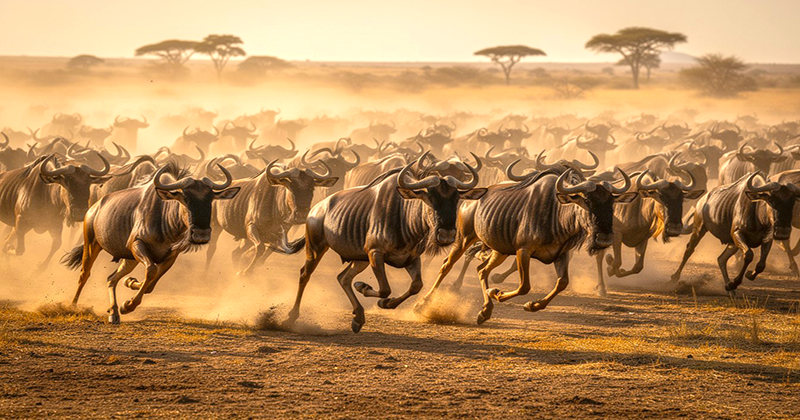
Every year, as the rains shift across East Africa, more than two million wildebeest rise almost as one and begin an 1,800-mile circular journey through the Serengeti and Maasai Mara ecosystems. The movement is vast, thunderous, and breathtaking—columns of animals stretching beyond the horizon, crossing crocodile-filled rivers, navigating predators, and pursuing fresh grazing lands with extraordinary precision.
What makes this spectacle even more remarkable is that no one teaches them the route.
Many calves are born in the middle of the migration itself. Within hours of birth, they stand on uncertain legs and join the moving herd, instinctively following a path they have never travelled. There are no leaders holding maps, no rehearsals, and no lessons passed down through instruction. Yet year after year, the migration unfolds with striking reliability.
The journey follows a rhythm that appears almost perfectly synchronized with environmental cycles. Calving season occurs in the southern Serengeti when grasses reach peak nutritional value. As dry conditions approach, the herds move northwest toward the Grumeti River, eventually pushing north to face the dramatic crossings of the Mara River before gradually returning south with the renewing rains.
The pattern is not random wandering but a finely tuned response to seasonal change.
Researchers suggest that wildebeest rely on multiple sensory cues. They can detect rainfall from great distances, recognize landscape features, follow the greenest grazing paths, and possibly sense subtle variations in Earth’s magnetic field. Their social structure also strengthens herd cohesion, helping individuals survive through collective movement.
Still, the migration raises deeper questions about how such complex coordination exists within animals that receive no formal learning. A newborn calf already responds to signals that guide survival—migration, herd following, and danger recognition—suggesting behavioural knowledge embedded within biological design.
Beyond individual survival, the migration sustains an entire ecosystem. The herds fertilize grasslands, nourish predators and scavengers, and support intricate food networks across the plains. Remove this migration, and the Serengeti would be fundamentally altered.
For many observers, the wildebeest migration becomes more than a natural event. It invites reflection on purpose, interdependence, and the possibility that life itself carries patterns written into its very fabric—patterns that guide movement, sustain communities, and remind us that some journeys begin long before we understand them known.
The wildebeest is just one example among thousands. In Fauna Unveils God, I explore the Arctic tern (44,000-mile migration), the Pacific salmon (navigating from ocean to natal stream), the monarch butterfly (a four-generation journey), and many more creatures whose navigational abilities challenge conventional explanation and invite reflection on intelligent design.